
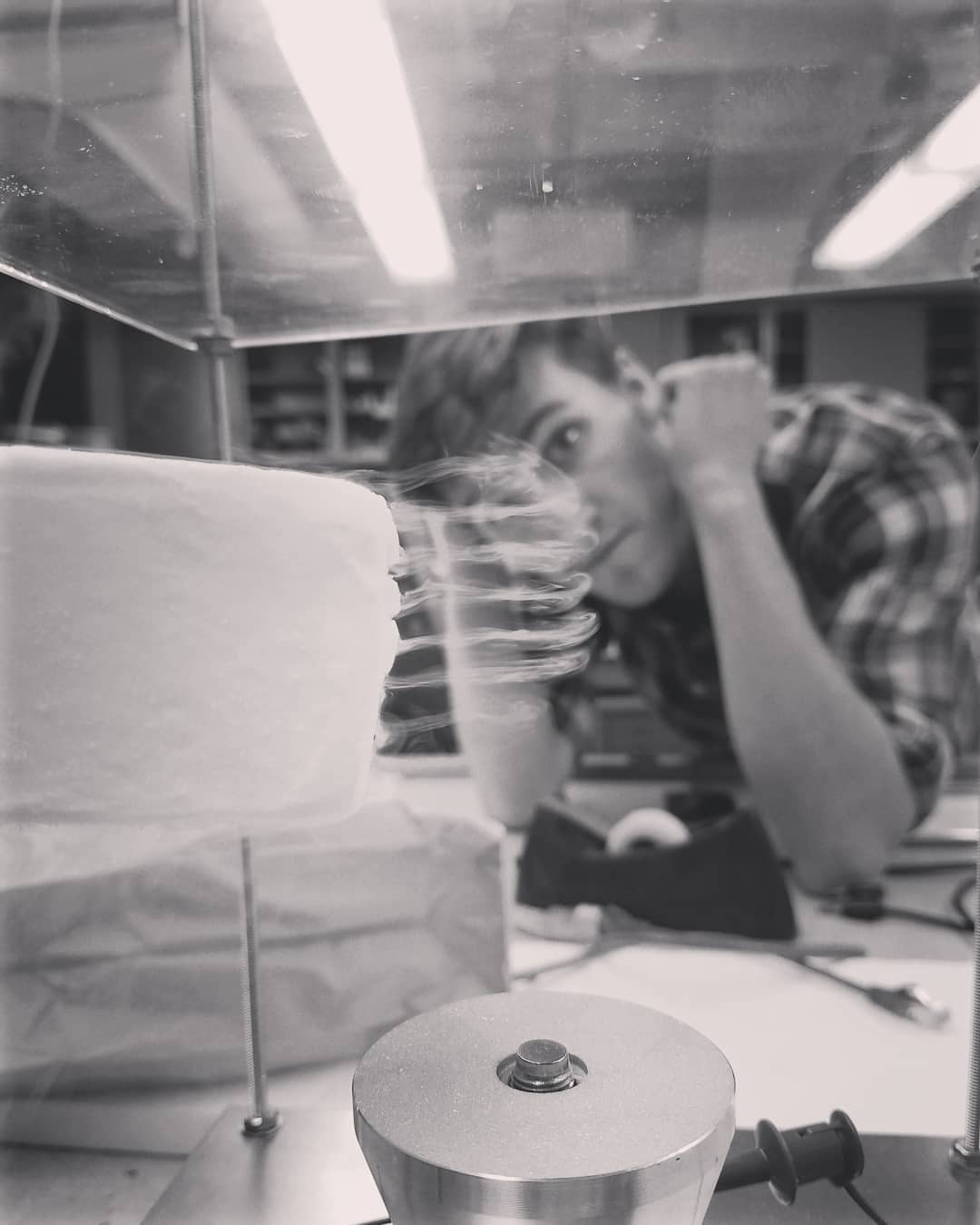
David J. Gillcrist is a PhD Candidate at the University of Massachusetts Dartmouth in their Engineering and Applied Science program with an emphasis in computational science and mathematics. His dissertation research involves investigating the intersections of differential geometry and surrogate modeling to inform better experimental design, parameter estimation, and calibration. Before attending UMass Dartmouth, he graduated Magna Cum Laude from Missouri University of Science and Technology with BSc’s in Physics and Applied Mathematics.
David has a rather diverse research pedigree and has been involved in research projects spanning several different scientific and mathematical disciplines. Most notably, as an undergraduate, he was involved in physical chemistry research, where he played a critical role in the construction of a chirped-pulse Fourier transform microwave spectrometer and aided investigations into the microwave spectra, corresponding to quantized rotational energy transitions, of various molecular complexes. Additionally, David has also had direct experience in particle physics research. He contributed to research for the ATLAS experiment at CERN investigating how the products of the theoretical vector boson Zd—called the “dark photon”—along with its hypothesized mass-giving scalar “a”-boson might be observed via beyond-standard model decays of the Higgs boson. Furthermore, David aided in the calibration research of the digital optical multipliers (DOMs) used by the IceCube Neutrino Observatory at the Amundsen-Scott South Pole station. These DOMs are designed to detect the Cherenkov radiation produced after high energy interactions between neutrinos and the glacial Antarctic ice.

Beyond the physical sciences and briefly before graduating from MS&T, David had the opportunity to explore the connections between rogue wave phenomena, studied in optics and oceanography, and the fractional nonlinear Schrödinger equation. Particularly, this exposure to fractional differential equations, and more generally fractional calculus, has molded one of David’s deepest curiosities and passions: to explore the frontier of fractional dynamics and discover what factors lead to its materialization in dynamical systems. Future research endeavors will hopefully see David using his knowledge of differential geometry and surrogate modeling to investigate fractional dynamics at a deep and insightful level.
I have no special talents, I am only passionately curious.
Albert Einstein, Letter to Carl Seelig, March 11, 1952 3
- This is a photo taken by my lab partner Brendan Ramsey after completing a project concerning acoustic levitation. ↩︎
- This portrait was taken by friend Dannika A. during a summer at University of Illinois Urbana-Champaign conducting research under Verena Martinez Outschoorn for the ATLAS experiment at CERN. ↩︎
- In letters between Albert Einstein and his biographer, Carl Seelig, Seelig inquired as to whether his aptitude in physics was due to intellect inherited from his father. In Einstein’s letter back he did not attribute his success in physics to anything inherited but merely to a curiosity in and passion for the subject. Albert Einstein Archives 39-12, 39-13, B.2.9b ↩︎
 David J. Gillcrist